Spend enough time at a gun range and you’ll see plenty of people who can shoot. Spend enough time studying real violence, and you begin to realize that shooting is only one small part of surviving it.
That distinction matters.
As firearms instructors, we spend a great deal of time helping students become more accurate, more efficient, and safer with their firearms. Those skills are essential. But they are only part of the equation. Because shooting is a skill. Fighting is a problem.
Hitting the Target Isn’t the Whole Story
On the range, life is fairly predictable. You know where the target is. You know when you’re going to shoot. You control the pace. There are no innocent bystanders moving through your line of fire, no verbal exchanges, no confusion, and no uncertainty.
Real life doesn’t offer those conveniences. A defensive encounter may begin with confusion rather than certainty. You may have to determine whether a threat actually exists before deciding whether a firearm should ever leave the holster.
That decision may be the most important one you make.
The Fight Begins Before the Gun Comes Out
One of the biggest misconceptions about self-defense is that the fight starts when the firearm is drawn. In reality, it usually starts much earlier. It starts with awareness.
It continues with recognizing potential problems before they become immediate threats. It involves creating distance, communicating clearly, setting boundaries, and avoiding unnecessary confrontations whenever possible.
If those efforts succeed, the firearm never becomes part of the solution. And that’s a good outcome. As renowned instructor Steve Tarani has often said, “If you’ve gone to guns, your protection plan has already failed.”
That doesn’t mean carrying a firearm isn’t important. It means a firearm should never be your only plan.
Training for Reality
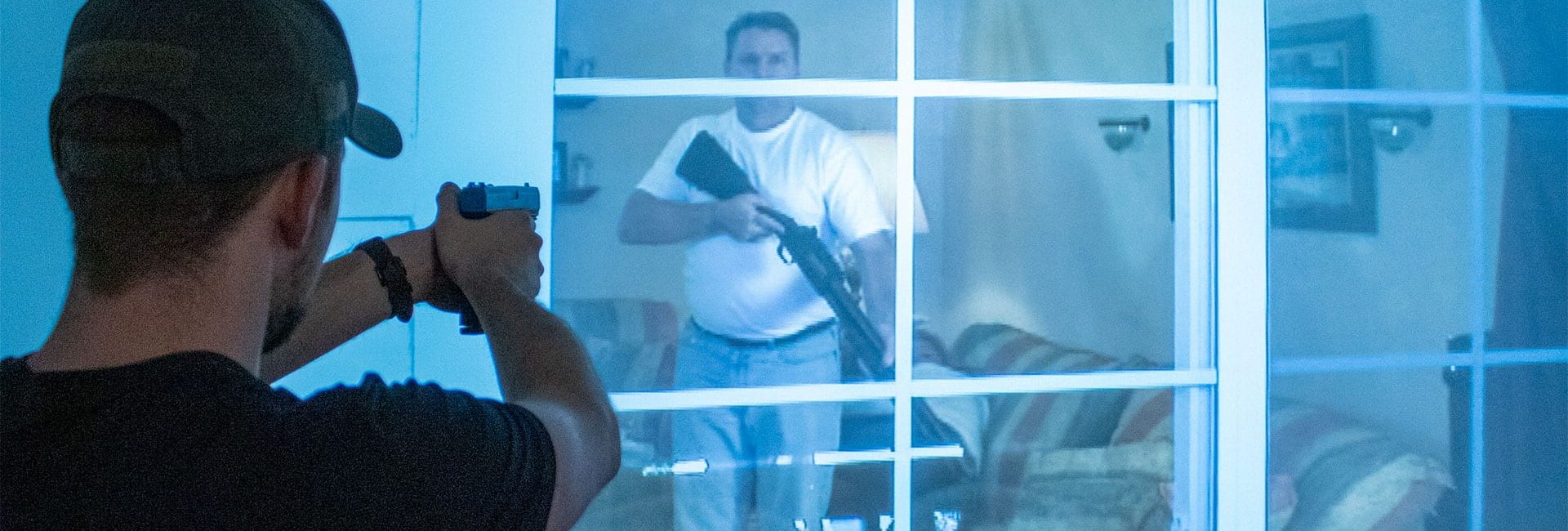
This is one reason we place such an emphasis on scenario-based training at C2 Tactical. Traditional range work builds marksmanship. Our SIM room helps build decision-making.
In simulator training, students are not simply trying to shoot accurately. They’re asked to identify threats, communicate, move, evaluate changing circumstances, and make decisions in real time. Sometimes the correct answer is to shoot. Sometimes it isn’t.
Those lessons are difficult to teach by simply standing in a shooting lane. Because fighting is rarely a marksmanship problem alone. It’s a judgment problem.
The Human Weapon System
The firearm is an important tool. But it is still just one part of a much larger system. That system includes awareness, judgment, communication, movement, emotional control, and the ability to make sound decisions under stress.
When any one of those pieces is missing, the entire system becomes less effective. The people who consistently perform well under pressure are rarely those with the most expensive equipment.
They are usually the ones who have developed the discipline to think clearly while everyone else is reacting emotionally.
The Bottom Line
Learning to shoot is an important accomplishment. Learning when to shoot, when not to shoot, how to avoid unnecessary violence, and how to solve problems under stress is an entirely different skill set.
At C2 Tactical, we believe both matter. Our goal isn’t simply to help people become better shooters. It’s to help them become better decision-makers. Because when everything is on the line, surviving the encounter isn’t just about hitting the target. It’s about solving the problem.